
Volume Performance Testing of a Warehouse Execution System
A Warehouse Execution System (WES) provider needed to run volume performance tests across many end-customer configurations, for days and weeks at a time, without leaning on a small team of highly skilled JMeter developers. Here's how they replaced fragile flows with low-code doppels.
See how the warehouse execution system was tested at volume
A walkthrough of how the WES was virtualized, simulated, and validated under volume conditions.
Validating a warehouse execution system under real operational pressure
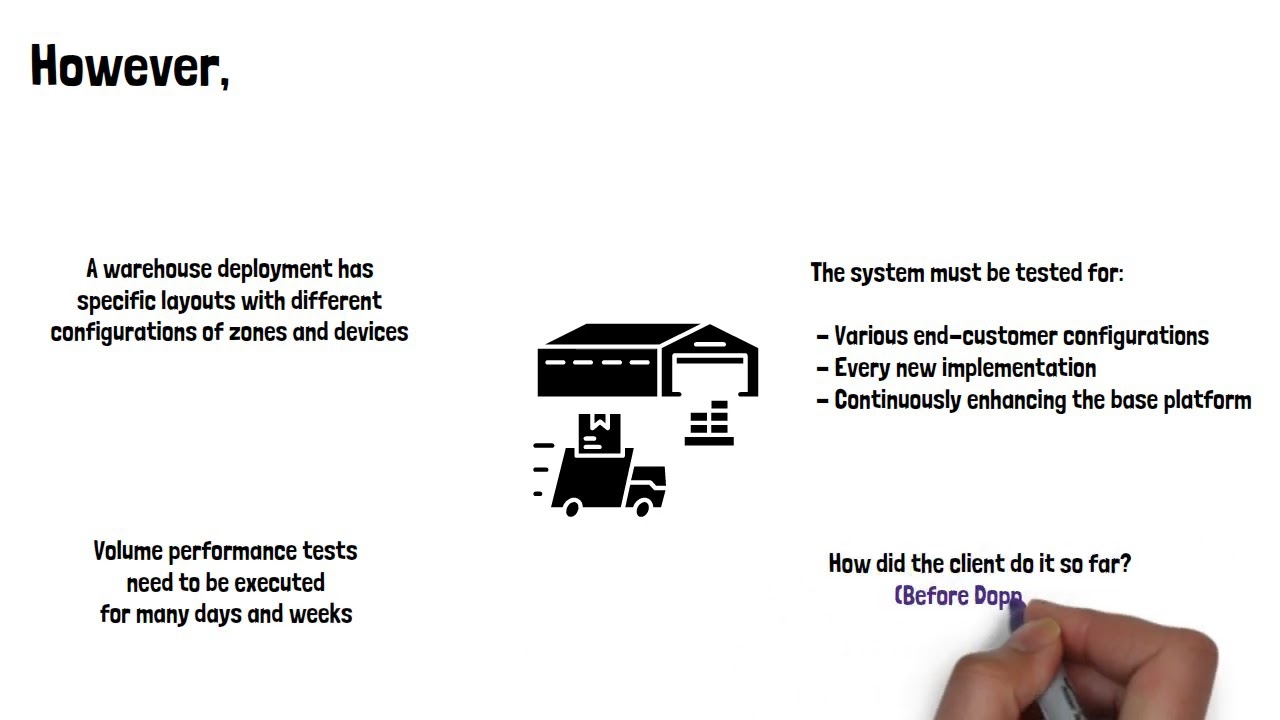
The customer had a Warehouse Execution System (WES) deployed with end customers who own distribution centers and warehouses. Four realities made volume performance testing especially demanding.
Material movement at the core
The WES moves material to manage inbound and outbound logistics for distribution centers and warehouses.
Orchestrating equipment and people
The WES allocates tasks across scanners, cranes, robots, and conveyor belts whenever an order is received.
Millisecond-level throughput
Every deployment has its own layout and zone configuration, with throughput expected within milliseconds.
Continuous testing pressure
The system had to be tested for every new end-customer configuration while the base platform was continuously enhanced, with volume tests running for days and weeks.
From fragile JMeter flows to low-code doppels at scale
- −Developed warehouse simulations using JMeter, with customer requirement-based scenarios built for each release
- −The JMeter performance engineering team spent significant time developing flows under a lot of constraints
- −Handling various asynchronous protocols using different JMeter plugins and libraries introduced performance bottlenecks
- −The reactive nature of the system needed highly skilled developers to code, debug, and maintain the flows
- −Running flows across multiple nodes and test environments in parallel over weeks was a significant challenge, with simulators slowing down and crashing over time
- −There was a lack of comprehensive coverage in testing the scenarios
- −Project timelines were uncertain due to inconsistent execution
- ✓Programmed asynchronous implementations in low code, within hours
- ✓Rapidly created various doppels, such as crane, user, and scanner doppels, and orchestrated them for different warehouse configurations
- ✓Came up with complex reactive flows quickly as the development team updated the design
- ✓Domain experts could manage testing without dependency on highly skilled JMeter flow developers
- ✓Ran tests for weeks across multiple test environments without simulators slowing down or crashing
- ✓Met all deadlines with comprehensive testing
View More Success Stories on IoT Testing
Get to know more about how we've solved diverse challenges when it comes to IoT Testing.