
How to Simulate BACnet at Scale
Gaurav Johri, Co-Founder and CEO, Doppelio
Last updated: Oct-19-2026
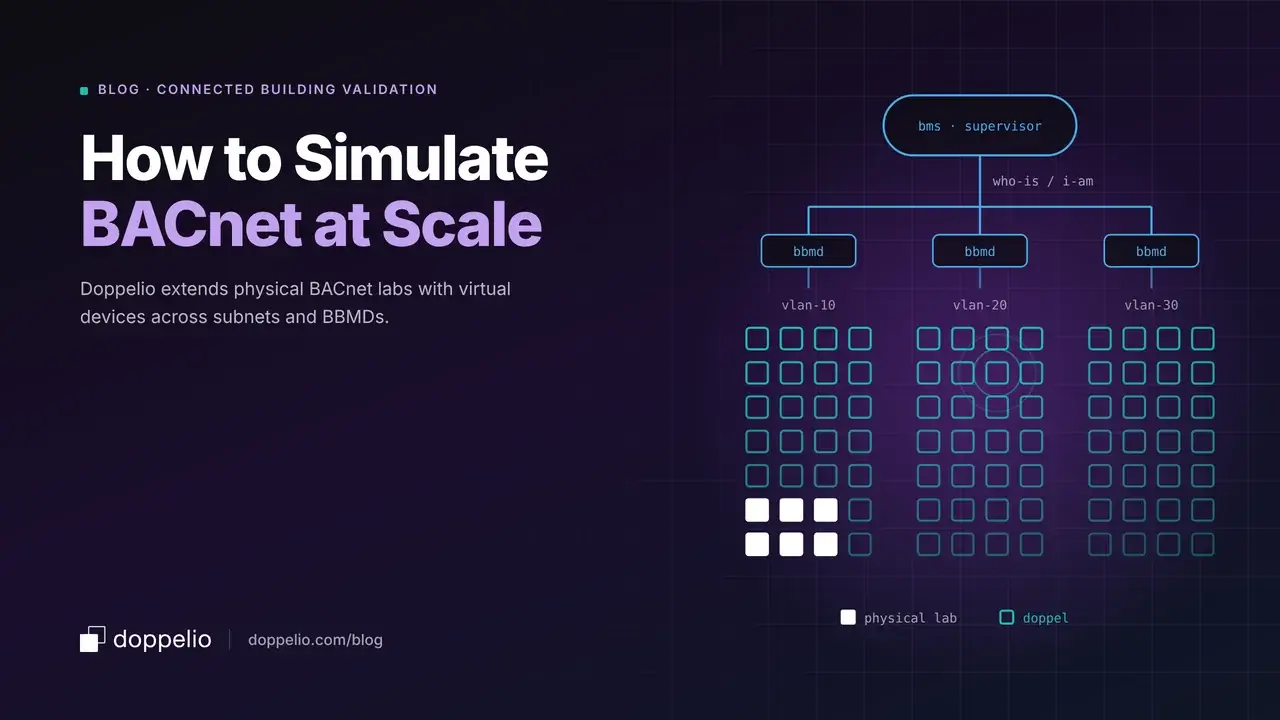
Table of Contents
Validating BACnet-based building automation systems at customer scale without assembling an equally large physical network.
A Building Management System (BMS) or Building Automation System (BAS) that works perfectly with 50 BACnet devices in a lab may behave very differently when deployed across a large commercial building with thousands of endpoints.
Device discovery takes longer, Change of Value (COV) notifications increase, alarms arrive simultaneously, and controllers must manage communication across multiple networks. These are conditions that are difficult to reproduce in a conventional test environment, yet they can significantly affect how the system performs once deployed.
For engineering teams developing BACnet controllers, supervisory platforms, and connected building applications, this presents a practical challenge. How do you validate the system against customer-scale deployments when your physical lab represents only a fraction of that environment?
The answer lies in extending physical BACnet labs through protocol-aware device virtualization and simulation. But before getting into that, it is worth understanding why BACnet scale testing is particularly challenging.
Why is BACnet difficult to simulate at scale?
BACnet (Building Automation and Control Networks) is a communication protocol widely used in building automation to enable interoperability between systems such as HVAC, lighting, energy management, and other building control applications.
Unlike conventional IoT applications that primarily communicate over IP-based protocols such as MQTT or HTTP, BACnet environments can involve multiple underlying network technologies.
BACnet/IP operates over IP networks, while BACnet MS/TP uses serial communication over RS-485. Newer variants, including BACnet/SC (Secure Connect), introduce secure communication over IP-based infrastructure.
This distinction matters when designing a test environment.
At scale, BACnet validation requires more than creating endpoints and generating traffic. The simulated devices must participate in BACnet communication and exhibit the protocol behavior the supervisory application expects.
For example, a supervisory application may discover devices using Who-Is and I-Am services, read their objects and properties, establish COV subscriptions, and receive notifications when monitored values change.
Simply generating thousands of synthetic sensor readings will not adequately validate these interactions.
There is also the network architecture to consider. BACnet/IP deployments spanning multiple IP subnets commonly rely on BACnet Broadcast Management Devices (BBMDs) to manage broadcast distribution.
A meaningful simulation must therefore account for device identity, object models, supported services, discovery, communication behavior, and the network topology being tested.
That network behavior is what makes BACnet scale difficult to reproduce. BACnet/IP relies on subnet-level broadcast behavior, so a realistic test may need thousands of devices distributed across tens or hundreds of VLANs, with BBMDs supporting communication across subnets. Recreating that physically means configuring and maintaining the corresponding network infrastructure, controllers, gateways, and supervisory applications. This is why BACnet validation has traditionally remained tied to on-premises labs, and why scale quickly becomes a constraint.
The physical BACnet lab has a scale ceiling
A typical BACnet validation lab contains a collection of physical controllers, field devices, network equipment, and the supervisory software being tested.
Such an environment is essential for validating hardware behavior, protocol interoperability, controller firmware, and integration with actual building equipment.
The limitation becomes apparent when the testing requirements move beyond individual device functionality.
Consider a BMS vendor whose software must support deployments ranging from small commercial buildings to large data centers. The engineering team may have sufficient hardware to validate the application with a few dozen or a few hundred endpoints.
But what happens when the customer deployment contains several thousand BACnet devices distributed across multiple subnets?
Replicating that configuration physically requires additional controllers, network equipment, wiring, configuration effort, and lab space. Every new customer topology or device variation adds to the setup and maintenance burden.
Even if the investment is justified, creating and reconfiguring these environments for every release is time-consuming.
Consequently, teams often validate functionality using available lab devices and defer larger-scale validation to pilot installations or customer deployments.
The risk is that several important issues only become visible when the number of devices, concurrent operations, and network complexity increase together.
What should you test before releasing a BACnet-based product?
BACnet scale validation should not be reduced to a test of how many devices a supervisory application can connect to.
The more useful question is whether the application continues to behave correctly when subjected to the communication patterns and operating conditions of an actual building.
Here are some important scenarios that deserve attention before a release.
Large-scale device discovery and initialization
Device discovery is one of the first activities performed when a BMS connects to a BACnet network.
Consider a large commercial building where hundreds of controllers and field devices must be discovered and their properties retrieved.
Testing discovery with 50 or 100 devices may establish functional correctness, but it does not necessarily reveal how the application handles thousands of devices responding within a short interval.
A scale test should validate whether the supervisory application can discover all expected devices, process concurrent responses, handle devices that respond slowly, and complete initialization within acceptable time limits.
It should also cover situations where devices become available at different times or return to the network after an outage.
COV subscriptions and sustained trend traffic
BACnet Change of Value (COV) notifications allow applications to receive updates when monitored values change, rather than continuously polling every property.
However, a large building can generate considerable notification traffic.
Imagine a connected HVAC installation with thousands of monitored points. As occupancy changes throughout the day, temperature readings, operating states, airflow values, and equipment status may change concurrently.
The test must establish how the supervisory application handles large numbers of COV subscriptions and the resulting notification traffic.
Important considerations include subscription management, notification processing, application responsiveness, and the accuracy of displayed or recorded values.
Trend traffic should also be tested under sustained load, particularly when multiple devices generate updates over extended periods.
The objective is to understand whether the platform can maintain reliable monitoring as the volume of active points increases.
Alarm bursts and concurrent events
Alarm handling deserves particular attention because real building conditions rarely produce events in isolation.
Take a connected building where a power disturbance causes multiple HVAC controllers and associated equipment to report faults within a short period.
Or consider a fire and safety monitoring integration where several monitored points change state during an incident.
The supervisory application may suddenly receive a large volume of events while continuing to process normal building telemetry.
Testing should verify whether all relevant events are received, processed, displayed, and recorded correctly. It should also examine alarm latency, event ordering where applicable, and the application's ability to remain responsive during the burst.
A useful test should combine normal operating traffic with abnormal event loads rather than testing alarms in an otherwise idle environment.
For fire and life-safety applications, this type of virtual testing complements, but does not replace, the required physical, integration, and compliance testing of certified safety systems.
Offline, intermittent, and recovering devices
A building network is not a permanently stable environment. Devices can become unavailable because of controller restarts, maintenance activities, communication faults, or network interruptions.
These conditions become more challenging when multiple devices are affected simultaneously.
For instance, what happens when an entire subnet becomes unreachable while the remaining building network continues to operate?
Does the BMS correctly identify unavailable devices? How does it handle existing subscriptions? What happens when those devices reconnect?
The test should validate recovery behavior, rediscovery where required, restoration of monitoring, and the handling of device state after communication resumes.
It is equally important to test partial failures. A system should not assume that every device within a network becomes available or unavailable at the same time.
Multi-subnet communication and BBMD behavior
Large BACnet/IP installations frequently extend across multiple IP VLAN subnets.
This introduces additional considerations around broadcast distribution, device discovery, and communication between different parts of the building network.
A test environment containing only devices on a single VLAN subnet cannot adequately validate these configurations.
Engineering teams should reproduce the intended customer topology, including multiple VLAN subnets and BBMD participation, and verify discovery and communication across network boundaries.
The same principle applies to BACnet/IPv6, where testing still needs to reflect the intended IP network topology. BACnet/SC is different. Communication is mediated through SC Hubs, so validation must represent the hub topology and device communication across hubs rather than applying the BBMD-based multi-subnet model used for BACnet/IP.
Sustained performance under customer-scale loads
A short load test can reveal immediate bottlenecks, but building automation systems are expected to operate continuously.
A more representative test would combine device discovery, periodic reads, COV notifications, trend traffic, and occasional alarm bursts over an extended period.
For example, simulate the operating cycle of a commercial building, from morning startup and increasing occupancy to peak HVAC activity and evening shutdown.
The purpose is to understand how the application behaves when different communication patterns overlap and whether performance remains consistent over time.
This also helps engineering teams establish practical capacity limits and identify resource bottlenecks before the software reaches a customer environment.
How do you extend a physical BACnet lab using virtualization?
The practical approach is not to eliminate the physical BACnet lab, but to extend it with virtual devices that behave like BACnet endpoints.
This is the architecture Doppelio uses to support customer-scale BACnet validation.
Doppelio creates virtual BACnet devices, called Doppels, whose behavior and capabilities can be configured to represent the devices being tested against.
The virtual environment works alongside the existing on-premises lab, allowing BACnet supervisory software, BMS applications, and controllers to interact with virtual endpoints as part of the test network.
At a capability level, Doppelio can extend an existing BACnet lab with virtual BACnet devices distributed across multiple VLANs and subnets. Teams can model different device types and counts in each subnet, assign unique IP addresses, control device data and service behavior, and validate discovery and communication through BBMDs.
This makes it possible to exercise customer-scale BACnet/IP and BACnet/IPv6 topologies with thousands of virtual devices without having to build and manage an equivalent physical network environment.
The engineering team can therefore expand the test environment without having to procure and assemble an equivalent number of physical controllers.
From a limited test bench to repeatable scale validation
Once the virtual BACnet environment is established, the testing process becomes more flexible.
Engineers can create different device populations, configure customer-specific network topologies, and execute scenarios against the application under test.
For example, a team validating a new BMS release could begin with its standard physical lab and extend the environment with a much larger virtual BACnet device population.
It could then execute a sequence of tests covering initial discovery, COV subscription traffic, simultaneous alarms, intermittent device availability, and recovery.
The same environment can be reused to validate subsequent releases or modified to represent a different customer deployment.
Doppelio also provides AI agents to assist with virtualization, scenario generation, test execution, and result analysis, reducing the manual effort involved in running and maintaining validation workflows.
Importantly, the objective is not simply to generate a high device count. It is to reproduce the behavior and interactions that place actual demands on the application being validated.
Virtualization does not remove the need for physical testing, especially where electrical characteristics, actual hardware behavior, serial bus timing, or certified safety functions must be verified. It addresses the scale and repeatability limitations that are difficult to overcome with physical infrastructure alone.
Validate for the building you are deploying into, not just the lab you have
A BACnet application may pass every functional test in a limited physical environment and still encounter performance or communication issues when deployed at customer scale.
For manufacturers of building controllers, BMS platforms, and connected building solutions, this creates an important validation gap.
The test environment must account for more than individual device functionality. It must represent the number of endpoints, network topology, communication patterns, concurrent events, and failure conditions that the application will encounter after deployment.
By combining existing physical BACnet infrastructure with virtual device populations and controlled simulation, engineering teams can test these conditions earlier, repeat them consistently, and validate larger customer configurations without building equally large physical labs.
Doppelio helps connected building teams extend their BACnet labs into customer-scale validation environments.
Explore Doppelio's connected product validation platform or contact info@doppelio.com to discuss your BACnet testing requirements.